Showing posts with label storytelling. Show all posts

Thursday, August 12

Player vs. player - or "The golden rule of roleplaying"

In our last game, the issue of player vs. player action came up. More specifically, one player said that his character did a mind control on another players character. This wasn't appreciated by the other player, who was open with it, so the first player changed his course of action.

The incident, however, got me thinking (and spurred some discussions on the groups Wave about the game). Several solutions were presented, like making that particular character immune to Domination etc, however, I think that those kinds of things should be settled outside of the game.

Now, the easy way is to say that "no player vs. player actions whatsoever". I think, however, that there is a deeper lesson to be learned. First of all, I'd like to separate character vs. character from player vs. player. Instead of making the situation a contest that one of the players win, make it a collaborative effort. First suggest (humbly) something along the lines of "It would fit the story and my character, and is a part of his downwards journey, if he tried to Dominate you in this particular situation. Would that be ok with you, and how would you like to play this out?" If, and only if, the second player agrees, the scene can be played out. The rules can still be used to decide if the power works, but the two players work together to make the scene interesting. This way, even though the character looses control, the player doesn't.

You can then add in a "give-and-take" approach, like the player running the controlled character can say something like "yes, you control my character for a little while, but in the process, he get's an insight into your mind, learning something from you", or something along those lines. But remember, this is an example of what can be done in addition to the above collaborative work.

The important part is that both players enjoy the situation and finds it interesting. In Swedish traffic law, there is the basic rule that basically states that "All drivers should at all times do as mush as possible to avoid accidents". That is the most important law, and all other laws are specifications and concrete rules about how to uphold/ fulfill that first law. That way of thinking could be applied to roleplaying games as well, written something like this:

"All players should at all times work towards making the game as 
enjoyable as possible for all participants"

That, my dear friends, is what I would call the "Golden Rule of Roleplaying"

Monday, July 12

Some thoughts on failure

Note: Very few of these thoughts are my own. They are picked up from different games and articles, and I just sum them up here.

GM: "Give me a skill-check on skill X"
Player: "Ok"
Rolls dice
Player: "Dammit, I fail"
GM: Ok then... you don't find anything/you fall down on your behind while trying to climb the wall/ nothing happens

Now, this is.. well, let's face it, not particulary exciting, is it?

In addition to this, there are two worst case scenarios here: The first is that the adventure comes to a grinding halt. The other is that after a while, the players tries again... and again.. and sooner or later he succeeds. Neither of these solutions are good (and the second solution is more or less an attempt to solve the first solution).

One thought I've read lately (among other places I've seen it in the excellent game Burning Wheel, by Luke Crane) is that in any one scene you only get one check for a particular skill or action. You need to cross that wall and you fail. Sorry, then the climb check has failed. No rerolls!

However, there are a few things you can do that makes things more interesting:

  • You as a player could change the circumstances. In most cases this means making things more serious. Can't find what you are looking for in that room? Well, try actually prying open the doors and the cupboards. People will see that you've been here, but you are allowed a reroll. In the case of social interaction, you could go from Diplomacy to Intimidation.. or to violence. The key word is "in order to get a reroll, change the circumstances significantly". Some games calls this "raising the stakes"
  • Instead of failing the attempt, the attempt is still a success. You climb that wall, you find what you are looking for. But there is a side effect. You are noticed by the guards or trigger an alarm. Yes, you convince someone to give you information with that failed diplomacy-check. However, they get annoyed with you and sell you out at the first opportunity.

Wednesday, May 19

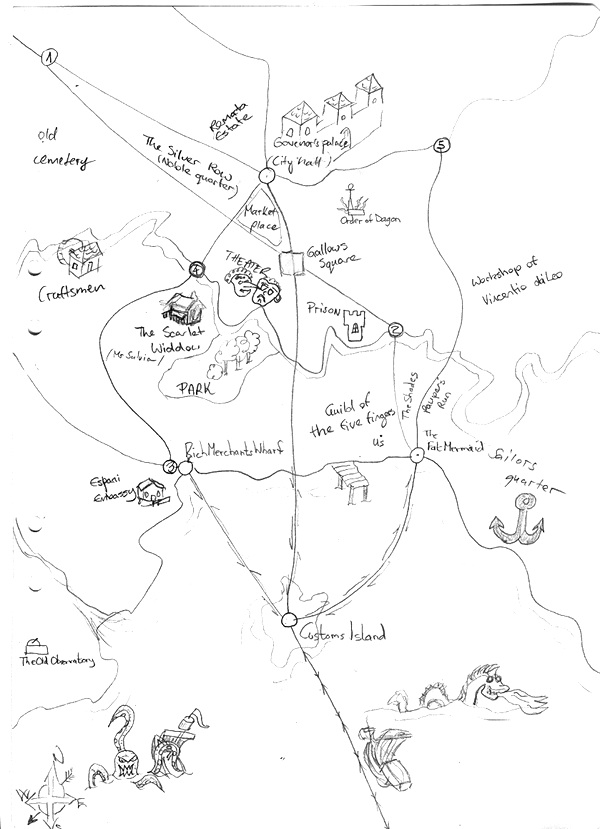
Low-prep map-making

The map to the left is a rough map over the city in which our latest campaign takes place. What's special with it is how it was created. Instead of me drawing the map before the gaming session (something that a: would take a lot of time and b: propably not resulting in a particulary interesting place), I tried another thing.

I let the players draw the map. Using the guidelines in Starblazers and Legends of Anglerre, the map was gradually built from nothing. After 15-20 minutes (roughly) the city grew in front of my eyes.

What helped, I think, was that this was actually the second session in this city, and I had been fairly clear with what style and genre the game was (I was aiming for a kind of medeival Venice/ Italy, with loads of conspiracies and intrigue).

My impression was that the players enjoyed doing it. We all got an immediate connection and relation to the city, and I didn't have to spend as much time preparing the game. The players also supplied me with numerous of interesting plot hooks and places that I could add into the campaign. On my evergoing quest towards minimizing prep-time, I think this was a successful experiment.

Monday, April 5

Not by luck, but by skill..

What if...

In a game, in an adventure, you as a GM tell the players "You will be defeated in every fight you enter... unless you do something about it"


They cannot rely on having luck with the dice.. they cannot rely on spending "action points" (or whatever they can be called in your game) to change the outcome of the rolls.


What they CAN do, however, is change the circumstances. They can do research of old legends to find out that the dragon is prone to staring at beautiful jewels, and then use that as a distraction. In space battle in a sci-fi setting, they can do a quick-and-dirty modification of their ship to boost the power of their guns (of course, with the result that they no longer can use their hyper-drive, and must limp to the nearest planet to fix it.. and have more adventures there).


Whatever happens, they must change the circumstances... they must change the odds to their advantage.

I don't know if this would work, but I'm willing to give it a try as an alternative to endless rolling of dice...

Friday, March 19

Everway - A humble praise

I've propably played over 50 different roleplaying games over the years.. some of these just end up as another book in the book-shelf. They were nice enough, but didn't bring anything new and notable. Then there are other games.. games that grab you.. that you learn to love.

One of these games is Everway. It was designed in the early 90's, but with ideas that can be considered modern today. It's focus on storytelling and drama is still one of the best I've seen.

I won't try to write everything I like with it in this blogg, but I will lift up a couple of highlights.
  • Everway is one of the few games that uses a truly qualitative system
  • You build your characters with pictures!
  • Adventures always has something at stake. The actions of the heroes changes the fate of many.
Finally, one of my most beloved characters of all times was an Everway-character. His name was Fourclover, and he was a storyteller and a fairy-tale dwarf. Always cheerful and with a pipe in his mouth, controlling the smoke, so that it formed pictures to follow his stories. He was a great little man, and he is the one that gave this blog it's name.

So, here's to you, Fourclover, and to the game that gave birth to you

Tuesday, March 16

Mapping out your adventure pt3


The next (and almost final) step is to fill in the blanks. The map from last post is decent as a starting point, but to build a more complex module we need to fill it in a bit more.

For each entity, I tried to add so there's at least 3 arrows to or from each entity (if possible), and to make sure that there are no "unconnected" groups in the map. In this step, I also try to add some more drama and interesting connections. In this case, I decided that Joanna (someone I added without knowing her purpose when I put her name down) was in love with the guardsman, and that gave her a weakness that the wizard might exploit. Another question to answer was WHY the wizard wants to cast the ritual. Revenge is always a nice motivator, so let's add that. Let's say that the guardsman stopped the wizard before.

So, I for each entity I added some more relations, adding more depth and drama to the story.

Looking at the diagram when I feel ready, I see the following situation.

Many years ago, Helvith the Tall thwarted the plans of the wizard Thuluman the Red. Thuluman went away, but didn't forget. Years later, he slowly returned, armed with the knowledge of a powerful ritual. He needed a very rare metall, secretium, for the ritual. This metal can be found in the crown of the dwarven clan. Therefore he exploited the weakness of a dwarf of the clan, Naug Grim, and put him into a gambling debt. Naug Grim then stole the crown, intending to hand it over to Thuluman.

The ritual also needed a sacrifice of someone who is emotionally attached to the victim. Joanna is a young woman who is in love with Helvith the Tall, and Thuluman used that to lure her into believing that the ritual will make Helvith fall in love with her.

There's still some things to fill in, but we now have a fairly solid framework with greed, revenge and romance from which to improvise an adventure together with the players.

Wednesday, March 10

Excel at relations.

Sometimes it's fairly important to keep track of relations between different persons and factions within an adventure or a module. This can be done in different ways, and one of these ways are a relational matrix.

A relational matrix is a grid with columns and rows (as matrices tend to be). In both the leftmost column and the top row you enter the participants of the adventure or story.

The way I usually do it is to have the column as the "active" part. That is, in the cell where a column meets a row, it's what the person in the column thinks about the person in the row.

So, in the example picture, you can see that Andy is afraid of John, for instance. In the cells where the person "meets himself" I just write down what he thinks about himself or his state of mind right now.

One of the uses is if course as a reference, I can have it in front of me when running the module. However, it's just as helpful when planning the module. I can start with the known relations, and then fill in a sufficient number of empty cells. It makes my work a bit more structured.

When I'm done, I can also try to see if any interesting scenes grow out of it naturally.

The example below was done in just a couple of minutes, but it didn't take me long before a semi-comples relational structure started to show up on the screen.

You can use basically any tool that has tables or grids on it for this. Many word processors have tables or you can use a spreadsheet like Excel to use it. In my example I used the spreadsheet function in Google Docs.

Sunday, July 26

About what to play..

Usually when I'm set out to write a module or adventure for a roleplaying game I usually start with the question "What game do I want to play?" and then I go from there, trying to write an adventure for a particular game.

I am more and more starting to think that that's a slightly flawed concept. (At least partially. For a long-running campaign, you are usually bound by what game is played in the campaign. )

So, what's the alternative? Perhaps, the question shouldn't be what game to play, but rather what I want to simulate/ "experience". From there, I can pick an appropriate game rather than the other way around.

Of course, there are situations where you want to pick a specific game (it has a new concept or interesting rules to try out), but overall at least my tendency is to think game first and "situation/story" later. I will try to change this, and first and foremost think about imagery, stories and scenes.

Tuesday, June 9

Wilderness of mirrors and narrative roleplaying - some thoughts

Not long ago, our gaming group tried out Wilderness of Mirrors for the first time. This was also one of our first sessions with improvisational, narrative roleplaying. The premise was the following: In our long going Star Wars Dawn of Defiance-campaign, one of the players have a subplot which includes a long lost sister.

To further that plot, we decided to play out  a rescue mission. Not with our regular characters, but with a group called the Antarian Rangers.  Also, since we like to try out new games at times (and have talked about some more narrative gaming for a while), we decided to use the Wilderness of Mirrors game by John Wick. This game can be found here: Wilderness of Mirrors [PDF] and a there is also a lengthy discussion about it on rpg.net on this thread

To sum it up, WoM is an agent-style game where you play your Jason Bournes and James Bonds. It is also a narrative, low-preparation game. Basically, the GM gives you a basic premise (Break in and rescue the diplomat, for instance) and then the players start to plan that rescue. When planning, the players can add things like "in order to take out those guards, we need a stun grenade" or "and when we enter that corridor, we have to hack the computer to shut down the weapon turrets". This way, the players build the adventure themselves. For each fact, the group get's a bonus die to add to their rolls when needed.

When the planning is done, the game starts, and together the GM and the players have the plan and the obstacles to use as the adventure. One important point is that skill-rolls don't actually decide if you succeed with an action or not, but rather, it decided who has narrative control. Even if you fail a roll, you might still succeed with the skill-check but the GM has the right to narrate what happens (which might include both good or bad things).

There is also an option in the game to add in negative stuff for other players (since betrayal and trust are major issues in agent movies), and this let's you get more dice. We didn't use that rule since we felt it didn't fit with the setting. However, in retrospect I have some thoughts on that. More on that later.

It should also be said that while all the players are experienced roleplayers, there is a varying degree of experience with more indie-type games.

When the GM told us to start planning, it did take a while for us to get into it. I'm guessing this is a matter of us being unused to the premise. However, after a while ideas where coming from all over the place. If there was one tendency it was to identify problems and then try to solve them in a fairly linear fashion. There wasn't so many ideas that introduced major obstacles or detours from the from-A-to-B-plot. I'm not saying this is a bad thing, but rather that it's a leftover from years of problem solving gaming.

The game itself went rather smoothly. As before, it felt a bit odd at times, and to some extent it was kept in the problem solving tradition. Basically, roll the dice, and if you roll good, you succeed with what you wanna do with no extra details around it. Now, it wasn't dull or plain, but I think that with some more experience in these kinds of games, we could have added more details and excitement to it ourselves.

There you have the next key-word: Excitement! Somehow, it didn't feel exciting, or as exciting as other games can do. To some extent I think it is a result of us as a group covering all bases with maxed attributes, but I also think that playing this kind of game with a problem-solving mindset is sub-optimal. It is to easy to "win".

So, you have to add that excitement yourself in one way or the other. We could have been better at this (again, I think it comes down to lack of experience) and added small tidbits ourselves. For instance, when we as players succeed with a roll, we have full narrative freedom. We can choose to make it easy for us (just say that we manage to do what we want) or to make it hard for us ("Yes, I shoot the masked Sith Inquisitor. However, when he falls to the ground his mask falls of, and I see that it's only a droid. It's a trap!!").

This is where I think the betrayal mechanic could come in handy. Perhaps not as betrayal as such, since that would be a bit out of genre, but as "Dark Side"-temptation-dice or something like that. There should perhaps be a limit to this, but basically, when I have narrative control, I should be able to add in something that makes it worse for me, another character or the group as such, and then get another bonus die. This way, another element of uncertainty is added to the game.

So, to sum up:
  • This kind of game requires some experience to run smoothly
  • It also requires some creativity and a mindset that it's not about problem solving, but finding interesting stories
  • Adding excitement can be a bit hard. In a game with more rules (D20 or similar) you can always fall back on the rules and die-rolls to add some excitement, but in these kinds of games, excitement have to be based on story and events.
  • Using some kind of "players as micro-opponents"-mechanic (be it Trust-dice or something else) is a good thing. Just as the players build the module in the planning stage, they can also add nasty and interesting side-effects in the actual game.
I would definately like to play these kinds of games more, but I also have to be better prepared with ideas and options so that I contribute to the drama and excitement of the game, and not just trust the GM to add those for me.